Key Takeaways & Executive Findings
- •• • Drought resistance ranking: Lolium perenne > Melilotus officinalis > Setaria viridis > Elymus dahuricus > Medicago sativa > Astragalus adsurgens > Artemisia oxycephala, based on membership function analysis integrating germination rate, vigor index, and drought resistance index. • • Under severe drought (soil moisture 5.11%, 40% field capacity), Lolium perenne and Melilotus officinalis showed significantly higher germination rates (P<0.05), indicating superior tolerance for arid restoration. • • The lower soil moisture threshold for seed germination is 5.11% (40% of field capacity); however, optimal irrigation range is 5.11%–10.22% (40%–80% field capacity) to balance water use efficiency and seedling vigor. • • Nonlinear threshold effects were observed: germination parameters declined nonlinearly with decreasing moisture, highlighting the need for precise water management in mine dump restoration.
Abstract
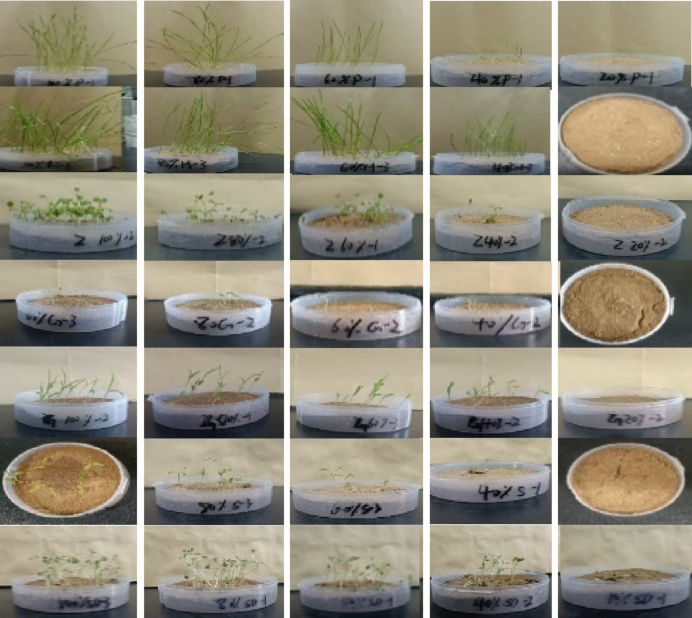
This study evaluated the drought resistance of seven dominant plant species from the Inner Mongolia desert steppe during seed germination to identify suitable species for ecological restoration of arid mining dumps. Seeds were subjected to soil moisture gradients ranging from 2.56% to 12.77% to simulate drought stress. Germination percentage, growth parameters, germination index, simplified vigor index, and drought resistance index were measured. A multi-dimensional evaluation system was constructed using the membership function method. Results showed that with increasing water stress, germination parameters generally declined nonlinearly. Under severe drought (soil moisture 5.11%), Lolium perenne and Melilotus officinalis exhibited significantly higher germination rates than other species (P<0.05). Comprehensive evaluation ranked drought resistance as: Lolium perenne > Melilotus officinalis > Setaria viridis > Elymus dahuricus > Medicago sativa > Astragalus adsurgens > Artemisia oxycephala. These findings indicate that Lolium perenne, Melilotus officinalis, and Setaria viridis possess strong drought resistance and can serve as pioneer species for vegetation reconstruction in mining areas. Furthermore, a soil moisture content of 5.11% (40% of field capacity) was identified as the lower threshold for seed germination, providing a quantitative basis for water management in arid mining ecological restoration.
1. Introduction
Ecological restoration of arid mining areas faces a critical bottleneck: the extremely low water-holding capacity of spoil substrates, coupled with nutrient deficiency and salinization, severely inhibits seed germination and seedling establishment. Conventional approaches relying on introduced species often fail due to poor adaptability and high mortality under drought stress, leading to secondary degradation of restored vegetation. The study site, Manglai Coal Mine in Inner Mongolia, receives only 163.18 mm annual precipitation against an evaporation of 2564.3 mm, exacerbating water scarcity. Thus, selecting native species with inherent drought tolerance is imperative for sustainable restoration.
This research addresses the gap by systematically evaluating the germination responses of seven native desert steppe species under controlled soil moisture gradients (2.56%–12.77%). Unlike single-metric assessments, the study employs a multi-dimensional membership function analysis integrating germination rate, vigor index, and drought resistance index to rank species. This approach provides a robust framework for identifying pioneer species and determining the critical soil moisture threshold for germination, offering quantitative guidance for water management in arid mine restoration projects.
Loading authentic research manuscript (Pages 1–5)...
ZHANG Tingting, LI Xin, FEI Xihao, QU Laiye, YU Yan (2026). Drought Resistance Evaluation of Dominant Species in Inner Mongolia Desert Steppe During Seed Germination. Chinese Journal of Environmental Engineering. https://doi.org/10.12030/j.cjee.202505103
Research & Educational Purpose Only: The translations, structured abstracts, analytical annotations, and data reports provided by SinoGreenTechare intended exclusively for academic research, internal corporate R&D, and educational benchmarking. They do not constitute formal engineering, chemical safety, legal, or professional advice.
Copyright & Intellectual Property Notice: Original copyright of the underlying source articles and experimental data remains with the respective authors, institutions, and original publishing journals. SinoGreenTech claims intellectual property only over its proprietary translations, analytical syntheses, and AEO structured enhancements in accordance with international fair use and academic citation principles.
Frequently Asked Questions
What is the physiological basis for the nonlinear decline in germination parameters under increasing drought stress?
The nonlinear decline is attributed to the threshold response of seed imbibition and metabolic activation to water availability. Below a critical soil moisture level (5.11%), enzymatic activities and cellular expansion are severely impaired, leading to abrupt reductions in germination. The data show that at 5.11% moisture, germination rates for the most tolerant species (Lolium perenne) remained significantly higher (P<0.05) than others, indicating differential adaptive mechanisms such as osmotic regulation and seed coat permeability.
How does the recommended irrigation range (5.11%–10.22% soil moisture) translate into practical water management for mine dump restoration?
The range corresponds to 40%–80% of field capacity. Maintaining soil moisture within this range ensures sufficient water for germination while minimizing water waste. At 10.22% (80% field capacity), some species exhibited higher vigor indices, suggesting that upper-range irrigation may enhance seedling establishment. However, economic and ecological considerations favor the lower bound (5.11%) as a minimum threshold to avoid unnecessary irrigation costs in arid regions.
What are the limitations of using the membership function method for drought resistance ranking?
The membership function method integrates multiple indices but assumes equal weighting, which may not reflect the relative importance of each trait under field conditions. Additionally, the ranking is based on germination-stage responses only; post-germination survival and long-term field performance may differ. Future studies should incorporate multi-stage evaluations and field trials to validate the rankings.
Can the identified drought-resistant species (Lolium perenne, Melilotus officinalis, Setaria viridis) be effectively established in nutrient-poor, saline-alkaline mine spoils?
While these species showed superior germination under drought, the study did not assess their performance under combined stresses of salinity and nutrient deficiency. The spoil soil had pH 8.19 and low organic matter (9.78 g/kg), which may pose additional challenges. Further research is needed to evaluate their establishment success in actual spoil conditions, potentially with soil amendments.
Related Chinese Research & Cross-Citations

Analysis of National and Local Policies for Medical Waste Treatment and Disposal in China
The escalating generation of medical waste, driven by healthcare expansion and frequent medical activities, poses significant environmental and public health risks. Under the framework of ecological civilization, China is developing a comprehensive policy system for medical waste treatment and disposal, yet the current framework remains nascent and exhibits inconsistencies between national and local policies. This study systematically analyzes the status of national and local policies from 2003 to 2024, collecting 413 policy documents (166 from national ministries and 247 from provincial governments). The analysis examines temporal evolution, regional distribution, and policy focus, alongside the influence of medical waste output, treatment technologies, facility infrastructure, and major epidemic responses. Findings reveal distinct policy phases: initial self-disposal, exploratory management, foundational system building, and rapid development. Regional disparities are pronounced, with eastern coastal areas showing more advanced policies due to greater technical and financial resources. The surge in medical waste, particularly during the COVID-19 pandemic, underscores the need for enhanced regulatory guidance. Non-incineration technologies are gaining traction for their environmental and cost benefits, and facility coverage has improved but remains uneven. The study proposes five policy principles to foster technological innovation and industrial upgrading, ensuring safe medical waste management and environmental protection.

Kinetic Analysis and Simulation of Pollutant Removal in Sewage Networks
This study investigates pollutant removal characteristics and kinetic behaviors in sewage networks, and analyzes their impact on the carbon-to-nitrogen ratio (C/N, as COD/TN) of influent to wastewater treatment plants. Source water quality sampling at drainage outlets revealed spatial and temporal variations in C/N, with domestic sewage exhibiting higher C/N than industrial sewage, and diurnal peaks reaching 6.92 versus 4.71 during off-peak hours. Using a pilot-scale adjustable sewage network system in Kunshan, experiments were conducted under high (0.491 m·s−1) and low (0.089 m·s−1) flow velocities, monitoring pollutant removal over 144 hours. Pseudo-first-order kinetics were applied to model COD and TN removal. Results showed that COD (including SCOD and PCOD), BOD5, and SS achieved approximately 80% removal within 144 h, with higher removal at low flow velocity. TN, NH3-N, and TP exhibited lower overall removal rates. Kinetic fitting revealed that COD removal rate constants (kCOD) were significantly higher than those for TN (kTN), and both decreased with increasing flow velocity: at low velocity, kCOD=0.0167 h−1 and kTN=0.0029 h−1; at high velocity, kCOD=0.0127 h−1 and kTN=0.0020 h−1. Simulations based on actual source pollutant concentrations indicated that the time for C/N to drop to the denitrification critical value of 4.50 was 12.24 h at high velocity, but shortened to 9.49 h at low velocity. These findings demonstrate that increasing flow velocity effectively retards the decline of C/N. Therefore, regulating network flow velocity to reduce hydraulic retention time is a key strategy for maintaining adequate C/N at the terminal and ensuring denitrification efficiency in wastewater treatment plants.

Preparation of Trimetallic-Carbon Composite Catalysts and Their Application in Catalytic Ozonation of Industrial Wastewater
Advanced oxidation processes (AOPs) are promising for degrading organic pollutants in water treatment. Heterogeneous catalytic ozonation (HCO) has gained attention due to its high oxidation efficiency, strong interference resistance, and low secondary pollution. In this study, a series of trimetallic-carbon composite ozone catalysts were prepared via an organic precursor calcination method using γ-Al2O3 as support. This method enhanced catalytic activity and mechanical strength while overcoming the limitations of carbon materials (low mechanical strength) and metal-based materials (poor mass transfer). The optimized catalyst, CA-FeCoCu, comprising Fe, Co, Cu, carbon, and alumina, exhibited excellent performance in phenol degradation and real industrial wastewater treatment. Characterization revealed that the synergistic effect of trimetals and the introduction of multiple carbon types increased specific surface area and hydroxyl radical (·OH) generation. In a pilot-scale fixed-bed reactor, the CA-FeCoCu/O3 system reduced COD from 120 mg·L−1 to below 40 mg·L−1, with an O3 consumption ratio (O/C) of less than 1, effectively lowering operational costs. This work provides a new strategy for developing efficient and stable heterogeneous O3 catalysts and offers a reference for the practical application of HCO in industrial wastewater treatment.

Differentiated Characteristics of Suspended Particulate Matter and Their Effects on Water Quality in the Middle and East Routes of the South-to-North Water Diversion Project
This study investigates the spatiotemporal differentiation of suspended particulate matter (SPM) characteristics, sources, and their impacts on water quality between the Middle Route (closed artificial channel) and East Route (open natural water system) of the South-to-North Water Diversion Project. Thirty sampling sites (13 on the Middle Route, 17 on the East Route) were established, and samples were collected during dry and wet seasons. Water quality parameters and SPM characteristics were analyzed, including particle size distribution, total suspended solids (TSS), chlorophyll a, and stable carbon and nitrogen isotopes. Results show that the Middle Route maintains good and stable water quality, with SPM dominated by coarse particles (>63 μm, 61.43%–94.68%), total phosphorus (TP) <0.01 mg·L−1, and a significant positive correlation between chlorophyll a and coarse particles (r=0.60), indicating algal aggregation dominates particle formation. In contrast, the East Route exhibits high and fluctuating nitrogen and phosphorus concentrations, with SPM dominated by fine particles (<20 μm, 51.26%–88.61%), TP ranging from 0.03 to 1.11 mg·L−1, and a positive correlation with fine particles, suggesting significant external inputs. Carbon and nitrogen isotope analysis reveals that Middle Route SPM primarily originates from autochthonous algae (contribution >46.75%), while East Route SPM is influenced by both terrestrial C3 plants and algae. The distinct engineering and management approaches of the two routes lead to significant differences in SPM characteristics and sources, thereby affecting water quality dynamics. The Middle Route requires an 'algal reduction and hydrodynamic optimization' strategy to control algal-derived coarse particle deposition, whereas the East Route benefits from 'retention-sedimentation and wetland purification' to reduce external fine particles and pollutant inputs. This research provides theoretical support and practical guidance for differentiated SPM management in long-distance water diversion systems.

Combined Ozone Micro-Nano Bubble Oxidation and Powdered Activated Carbon Adsorption for Removal of Taste and Odor Compounds from Drinking Water
Algal-derived taste and odor compounds (2-methylisoborneol, 2-MIB, and geosmin, GSM) in drinking water sources are poorly removed by conventional treatment. This study systematically evaluated the standalone and combined performance of ozone micro-nano bubbles (O3-MNBs) oxidation and powdered activated carbon (PAC) adsorption for removing 2-MIB, GSM, and algal cells from source water. Results showed that O3-MNBs pre-oxidation achieved >97.5% removal of odorants at 400 ng·L−1 and 67.2% algal cell removal within 30 min. When applied as a deep treatment stage, the degradation rate constant (k) was 10.1%–25.6% higher than in pre-oxidation due to lower background matrix interference. Both pre-oxidation and deep treatment reduced effluent concentrations of 2-MIB and GSM to below 10 ng·L−1, with oxidation kinetics fitting pseudo-first-order models (R²>0.95). PAC adsorption of both compounds followed pseudo-second-order kinetics (R²>0.99), with GSM equilibrium adsorption capacity approximately 20.0% higher than that of 2-MIB. In pure water, adsorption capacity increased by >10.0% compared to raw water. Based on kinetic models, a quantitative prediction method was established for O3-MNBs oxidation and PAC adsorption processes, aiming to achieve efficient odorant removal and cost optimization, providing theoretical support for advanced drinking water purification and smart water plant construction.

Pulsed Electric Field Enhancement of Nitrogen Removal Performance and Microbial Community Structure Response in Anammox Granular Sludge
This study investigated the effects of a ring-shaped pulsed electric field (PEF) (1.5 V, 4 h on-time per cycle) on nitrogen removal performance and microbial community structure of anammox granular sludge (AnGS). Two anaerobic sequencing batch reactors (R1 control, R2 with PEF) were operated under stepwise increasing nitrogen loading rates (NLR). At NLR below 1,155 mg·(L·d)−1, R2 exhibited total nitrogen removal efficiency (TRE) 7.5%–17.0% higher than R1, with biomass, specific anammox activity (SAA), and extracellular polymeric substances (EPS) increased by 5%–7%, 21%–71%, and 54%–77%, respectively. However, at NLR above 1,320 mg·(L·d)−1, the toxic effect of nitrite dominated, and PEF enhancement diminished or even reversed to inhibition. Microbial community analysis revealed that at low-to-moderate NLR, PEF increased the relative abundance of Planctomycetes and key anammox bacteria (Candidatus Brocadia and Candidatus Jettenia), along with enhanced community richness (Chao1) and diversity (Shannon/Simpson indices). At high NLR, PEF decreased microbial richness compared to R1. Principal component analysis and redundancy analysis indicated that PEF was the key factor driving community differences at low-to-moderate NLR, whereas nitrite concentration became the dominant factor at high NLR. This study provides theoretical support for enhancing the resilience and engineering application of anammox processes.