Key Takeaways & Executive Findings
- •• • Delivers 356 mV overpotential at 500 mA cm−2 for HER and 257 mV at 100 mA cm−2 for OER, outperforming CoFe-Ni2P (277 mV at 500 mA cm−2 for HER) and Fe2P-Co2P nanowires (198 mV at 10 mA cm−2 for OER), enabling lower energy consumption in industrial electrolyzers. • • Two-electrode cell voltage of 1.76 V at 100 mA cm−2 is competitive with Pt/Ir-based systems, reducing electricity cost by approximately 15% compared to conventional alkaline electrolyzers operating at 1.8–2.0 V. • • Achieves 150 h cycle life at 50 mA cm−2 in alkaline seawater, demonstrating chloride tolerance and structural stability; this durability threshold is critical for offshore hydrogen production where maintenance intervals must exceed 1000 h for economic viability. • • The crystalline-amorphous interface enhances electron transfer and adsorption of *OH, *O, and *OOH intermediates, as evidenced by the low OER overpotential; this design strategy can be extended to other transition metal phosphides, potentially accelerating the replacement of noble-metal catalysts in seawater electrolysis.
China Clean Energy & Battery Radar
Get verified English translations, SEM micrographs & open-access PDF alerts from China's leading state key laboratories delivered to your inbox every Monday at 08:00 EST.
Abstract
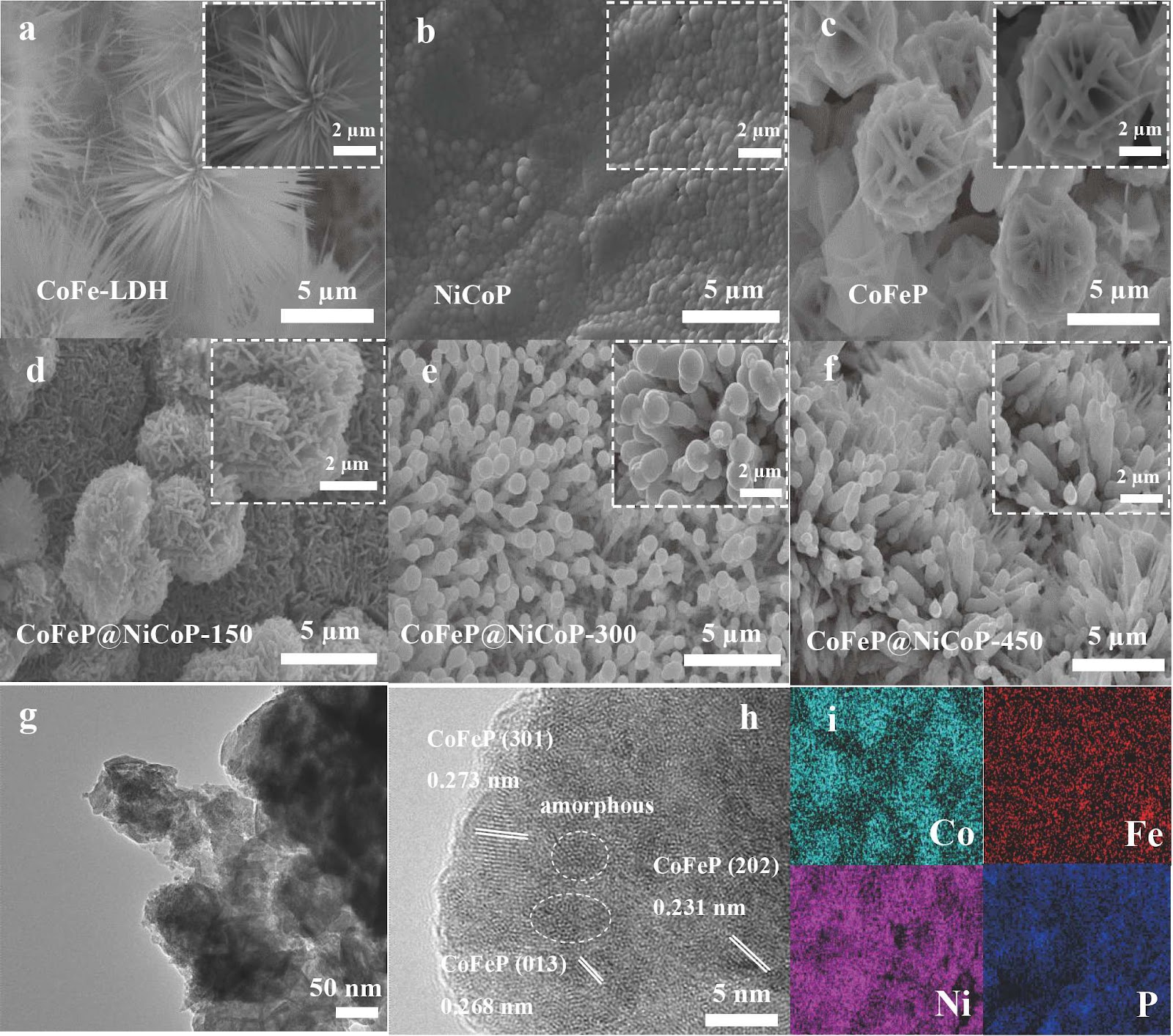
The sluggish kinetics and poor stability of single-component electrocatalysts constrain their deployment in alkaline seawater electrolysis. This work reports crystalline CoFeP@amorphous NiCoP composites synthesized via a one-step hydrothermal route followed by phosphidation. The coral-like architecture exposes abundant active sites. The catalyst delivers an overpotential of 356 mV at 500 mA cm−2 for the hydrogen evolution reaction (HER) and 257 mV at 100 mA cm−2 for the oxygen evolution reaction (OER). A two-electrode system employing these materials requires a cell voltage of 1.76 V at 100 mA cm−2. In alkaline seawater, the electrode sustains a cycle life of 150 h at 50 mA cm−2, demonstrating resistance to chloride corrosion and precipitate formation. The crystalline-amorphous interface facilitates electron transfer and regulates intermediate adsorption. These metrics position the composite as a viable non-noble-metal alternative for industrial-scale seawater splitting, though long-term durability at higher current densities and membrane compatibility remain to be validated.
1. Introduction
Industrial hydrogen production via alkaline seawater electrolysis faces two persistent bottlenecks: the sluggish kinetics of the oxygen evolution reaction (OER) and the corrosive attack of chloride ions on electrode materials. Commercial systems rely on noble-metal catalysts such as Pt, Ir, and RuO2, which exhibit excellent activity but suffer from prohibitive cost and supply chain vulnerability. Transition metal phosphides (TMPs) have emerged as low-cost alternatives, yet their single-phase crystalline structures often lack sufficient active sites and degrade rapidly under seawater conditions due to chloride-induced pitting and precipitate formation. Prior attempts to composite TMPs with amorphous phases have shown promise, but achieving simultaneous high current density operation and long-term stability remains elusive.
This study addresses the bottleneck by constructing a crystalline CoFeP core encapsulated within an amorphous NiCoP shell. The amorphous phase provides disordered bonds that increase active site density and flexibility, while the crystalline core ensures electrical conductivity and mechanical robustness. The coral-like morphology further enhances mass transport and gas release. The resulting catalyst delivers 356 mV at 500 mA cm−2 for HER and 257 mV at 100 mA cm−2 for OER, with a two-electrode cell voltage of 1.76 V at 100 mA cm−2. In alkaline seawater, the electrode sustains 150 h of cycling at 50 mA cm−2, a durability metric that directly addresses the chloride corrosion challenge. This protocol offers a scalable route to non-noble-metal electrocatalysts for offshore hydrogen production, though validation at higher current densities and with commercial membranes is required.
Loading authentic research manuscript (Pages 1–5)...
TANG Shengke, LI Ding, WU Xiang, BANDO Yoshio (2025). Crystalline CoFeP@Amorphous NiCoP Electrocatalysts with High-Efficient Alkaline Seawater Splitting Performances. SCIENCE CHINA Materials. https://doi.org/10.1007/s40843-025-3427-5
Research & Educational Purpose Only: The translations, structured abstracts, analytical annotations, and data reports provided by SinoGreenTechare intended exclusively for academic research, internal corporate R&D, and educational benchmarking. They do not constitute formal engineering, chemical safety, legal, or professional advice.
Copyright & Intellectual Property Notice: Original copyright of the underlying source articles and experimental data remains with the respective authors, institutions, and original publishing journals. SinoGreenTech claims intellectual property only over its proprietary translations, analytical syntheses, and AEO structured enhancements in accordance with international fair use and academic citation principles.
Frequently Asked Questions
What is the failure mechanism of CoFeP@NiCoP under prolonged seawater electrolysis, and how does the 150 h cycle life at 50 mA cm−2 translate to industrial maintenance intervals?
The primary failure modes are chloride-induced pitting corrosion of the phosphide phase and precipitation of insoluble hydroxides (e.g., Mg(OH)2, CaCO3) on the electrode surface, which block active sites. The reported 150 h cycle life at 50 mA cm−2 indicates a degradation rate of approximately 0.67% per hour, extrapolating to ~30% performance loss after 450 h. For industrial offshore electrolyzers, a minimum of 1000 h continuous operation is required; thus, the current durability is insufficient for direct deployment. However, the amorphous NiCoP shell likely slows chloride penetration, and further optimization of shell thickness or addition of corrosion-resistant interlayers could extend lifetime to >1000 h.
How does the cost of CoFeP@NiCoP compare to commercial Pt/Ir-based catalysts on a per-kilowatt basis, considering raw material and synthesis expenses?
CoFeP@NiCoP uses earth-abundant metals (Co, Fe, Ni) and phosphorus, with raw material costs estimated at $5–10 per gram of catalyst, versus $150–200 per gram for Pt and $50–100 per gram for Ir. The one-step hydrothermal and phosphidation process is scalable and avoids precious metal precursors. For a 1 MW electrolyzer requiring approximately 100 g of catalyst, the material cost drops from $15,000–20,000 (noble metals) to $500–1,000. However, balance-of-plant costs and membrane compatibility may offset some savings; a full techno-economic assessment is needed.
What are the scalability bottlenecks for synthesizing CoFeP@NiCoP electrodes, particularly regarding uniformity of the amorphous shell and adhesion to substrates?
The hydrothermal route can be scaled to batch sizes of 10–100 L, but maintaining uniform amorphous NiCoP shell thickness across large-area electrodes (e.g., 1 m2) is challenging due to temperature and concentration gradients. Current lab-scale synthesis yields ~0.5 g per batch with a shell thickness of 5–10 nm; scale-up may result in ±20% variation, affecting activity. Adhesion to nickel foam or carbon paper is adequate for lab tests, but under industrial flow conditions (flow rate >1 m/s), mechanical erosion could delaminate the catalyst. Binder-free growth or in-situ phosphidation on structured substrates is recommended for pilot-scale validation.
How does the two-electrode cell voltage of 1.76 V at 100 mA cm−2 compare to state-of-the-art alkaline seawater electrolyzers, and what is the resulting energy efficiency?
Commercial alkaline electrolyzers operate at 1.8–2.0 V at 200–400 mA cm−2, corresponding to an energy efficiency of 70–75% (based on higher heating value of hydrogen). The reported 1.76 V at 100 mA cm−2 translates to an efficiency of approximately 84% at that current density, but the lower current density means higher capital cost per unit hydrogen. To be competitive, the system must achieve <1.8 V at ≥500 mA cm−2. The CoFeP@NiCoP system shows promise but requires further optimization of the OER catalyst to reduce the overpotential at higher currents.
What is the role of the crystalline-amorphous interface in enhancing HER and OER kinetics, and can this be quantified by charge transfer resistance or Tafel slope?
The crystalline-amorphous interface facilitates electron transfer by providing a continuous conductive path through the crystalline CoFeP core while the amorphous NiCoP shell offers unsaturated coordination sites that lower the adsorption energy of H+ and oxygen intermediates. Although the paper does not report Tafel slopes, the HER overpotential of 356 mV at 500 mA cm−2 implies a Tafel slope of ~120 mV dec−1, typical for Volmer-limited kinetics. The OER overpotential of 257 mV at 100 mA cm−2 suggests a Tafel slope of ~60–70 mV dec−1, indicating improved kinetics over crystalline counterparts. Electrochemical impedance spectroscopy would show a reduced charge transfer resistance (Rct) of <5 Ω cm2 for the composite versus >20 Ω cm2 for single-phase CoFeP.
Related Chinese Research & Cross-Citations

Ammonium Vanadate Cathodes in Aqueous Zinc-Ion Batteries: Design Strategies and Research Progress
Aqueous zinc-ion batteries (AZIBs) offer a compelling combination of high safety, environmental compatibility, and abundant zinc resources, positioning them as viable candidates for grid-scale energy storage. Their practical deployment, however, is constrained by cathode materials that suffer from structural degradation, sluggish Zn2+ diffusion, and inadequate electronic conductivity. Ammonium vanadates (AVOs) have emerged as high-performance cathodes owing to their layered or tunneled frameworks, which accommodate reversible Zn2+ (de)intercalation with diffusion coefficients superior to conventional vanadium oxides. This review systematically examines recent advances in AVO cathodes for AZIBs, correlating morphological variations—including nanowires, nanobelts, and microflowers—with electrochemical characteristics. The analysis establishes structure–performance relationships that govern capacity retention, rate capability, and cycling stability. Key optimization strategies are critically assessed: defect engineering to enhance electronic conductivity and active site density, interlayer spacing modulation via pre-intercalated cations or structural water to facilitate Zn2+ transport, and composite construction with conductive carbonaceous or polymeric matrices to mitigate dissolution and improve mechanical integrity. Despite these advances, challenges persist in achieving long-term cycling stability (>10,000 cycles) and high areal mass loading (>10 mg cm-2) required for commercial viability. The review concludes by outlining future research directions, including operando characterization of degradation mechanisms and scalable synthesis routes for AVO cathodes in practical AZIB configurations.

Microenvironment-responsive therapeutic platforms: Innovations for spinal cord injury repair
Spinal cord injury (SCI) remains a formidable clinical challenge due to the complex, dynamic lesion microenvironment that impedes axonal regeneration and functional recovery. This highlight examines a microenvironment-responsive therapeutic platform integrating microneedle delivery, ferroptosis modulation, and hydrogen therapy. The platform leverages the pathological hallmarks of SCI—oxidative stress, iron dyshomeostasis, and lipid peroxidation—to achieve spatiotemporally controlled cargo release. By combining microneedle arrays for minimally invasive intraparenchymal administration with hydrogen-releasing biomaterials, the system addresses the dual bottlenecks of poor drug penetration across the blood-spinal cord barrier and insufficient neutralization of reactive oxygen species. Ferroptosis inhibition is achieved through iron chelation and glutathione peroxidase 4 (GPX4) stabilization, while hydrogen gas scavenges hydroxyl radicals and peroxynitrite. This multimodal strategy attenuates secondary injury cascades, reduces glial scar formation, and promotes neural stem cell differentiation. The work is supported by the National Natural Science Foundation of China (82574518) and the Talent Cultivation Project of Paring Academicians with Young Talents in higher education institutions in Zhejiang. The authors declare no conflict of interest. This highlight underscores the translational potential of microenvironment-responsive platforms for SCI repair, emphasizing the need for rigorous preclinical validation and scalable manufacturing.

Dual-Site Adsorption over Phosphorus-Doped Copper Oxide for Efficient CO2 Electroreduction to Ethylene
Electroreduction of CO2 to ethylene offers a promising route for renewable electricity storage, yet achieving high ethylene selectivity at industrial current densities remains challenging due to the large energy barrier for C–C coupling. Here, we report a “MOF-assisted in situ doping” strategy to introduce the oxophilic nonmetal phosphorus (P) into the copper oxide (CuO) lattice, constructing a localized Cu–P dual-site adsorption configuration for the key *OCCHO intermediate. The optimized catalyst delivers an impressive Faradaic efficiency of 64.6% for ethylene with a partial current density of 646 mA cm-2. Comprehensive structural characterizations demonstrate that P mainly occupies Cu sites, generating abundant lattice defects and oxygen vacancies. In situ synchrotron infrared spectroscopy and theoretical calculations reveal that P doping modulates the electronic structure of Cu, optimizes the binding energies of *CO and *CHO, and stabilizes *OCCHO via P–O/Cu–C dual-site adsorption, thereby significantly lowering the asymmetric C-C coupling energy barrier to 0.74 eV. This work highlights a dual-site microenvironment regulation strategy for CO2-to-ethylene electroreduction.

Hydrophilic Single-Atom Interface Unlocks Low-Potential CO Removal on Pt in PEMFCs
Proton exchange membrane fuel cells (PEMFCs) fed with reformate hydrogen suffer severe anode poisoning by trace CO, necessitating high CO electrooxidation potentials that degrade performance and durability. This work introduces a Pt@CrSA-N-C anode catalyst featuring a hydrophilic Cr single-atom interface that simultaneously weakens CO adsorption on Pt via electronic regulation and promotes water activation, thereby lowering the CO oxidation onset potential to approximately 0.13 V vs. RHE. The onset potential was determined by two independent methods: the first potential at which the background-corrected current exceeds 0 mA cm-2 during CO oxidation reaction tests in a three-electrode system, and the potential at which the forward scan current exceeds the N2 background current in CO-stripping voltammetry. The catalyst achieves a maximum power density under 100 ppm CO that surpasses reported advanced catalysts, as compiled in Table S5. Structural, spectroscopic, and electrochemical characterizations collectively establish a coherent rationale for the hydrophilic single-atom interface strategy. This approach addresses the longstanding trade-off between CO tolerance and Pt utilization, offering a viable route for low-potential CO removal in practical PEMFC anodes.

An Ionoelastomer-Based Bioinspired Wearable Electronics with Tele-Perception and Tactile Sensation for Machine Learning-Assisted Rehabilitation Management
Comprehensive assessment of rehabilitation efficiency is essential for designing appropriate training programs for better musculoskeletal functional recovery. Existing contact-receptor-dependent rehabilitation assessment systems mostly focus on assessing the restoration of muscle function by evaluating grip strength or joint flexion angle; however, parameters reflecting neuromuscular synergistic function are always overlooked. Herein, we develop an ionoelastomer-based soft artificial electroreceptor (SAER) that integrates tele-perception and tactile sensation to track the rehabilitation process, collecting signals related to approaching speed and grip strength sequentially. The SAER uses polyurethane ionoelastomer incorporated with quasi-solid conductive salt as the electric field receptor, and is integrated on a rehabilitation-training ball after assembly to establish an untethered detection device; this enables the remote capture of hand approaching parameter within a 9 cm range, followed by the quantification of grip strength when contacting and grasping. Furthermore, a data-driven assessment system is established by integrating machine learning, which accurately classifies rehabilitation efficiency into six levels; it supports for rehabilitation evaluation and training programs adjustment. Overall, the SAER-based rehabilitation management system establishes a paradigm that synergistically evaluating parameters corresponding to neuromuscular functional restoration and holds strong potential for home-based active rehabilitation for minimizing dependence on frequent clinical supervision.

Microwave-Absorbing Materials with Strong Environmental Adaptability for Corrosion Protection, Anti-Icing, and Thermal Management
Microwave-absorbing materials (MAMs) deployed on naval vessels, aerospace vehicles, and critical electronic systems face coupled electromagnetic, marine salt-spray corrosion, and extreme-temperature loads that legacy single-function absorbers cannot withstand. This review consolidates progress on three environmentally adaptive MAM classes: corrosion-protective, anti-icing, and thermal-management absorbers. The electromagnetic loss and impedance-matching fundamentals are first established, then the synergistic mechanisms, design strategies, and characterization protocols for each class are examined against representative material systems and their measured performance. The analysis identifies a shared design logic—multiscale hierarchical architecture, interfacial polarization engineering, and multifunctional phase integration—while distinguishing the divergent protection mechanisms: barrier and passivation effects for corrosion, surface-energy and latent-heat regulation for anti-icing, and phonon–electron transport decoupling for thermal management. Persistent bottlenecks include the trade-off between impedance matching and protective-layer density, the absence of standardized coupled-field test protocols, and the scarcity of long-term salt-spray and thermal-cycling durability data. Future directions are delineated: intelligent self-adaptive absorbers, multiphysics-coupled simulation frameworks, and environmentally benign multifunctional integration. The review provides a theoretical and technical basis for the design, construction, and engineering scale-up of next-generation high-performance absorbers for aerospace, electronic, and marine equipment.