Key Takeaways & Executive Findings
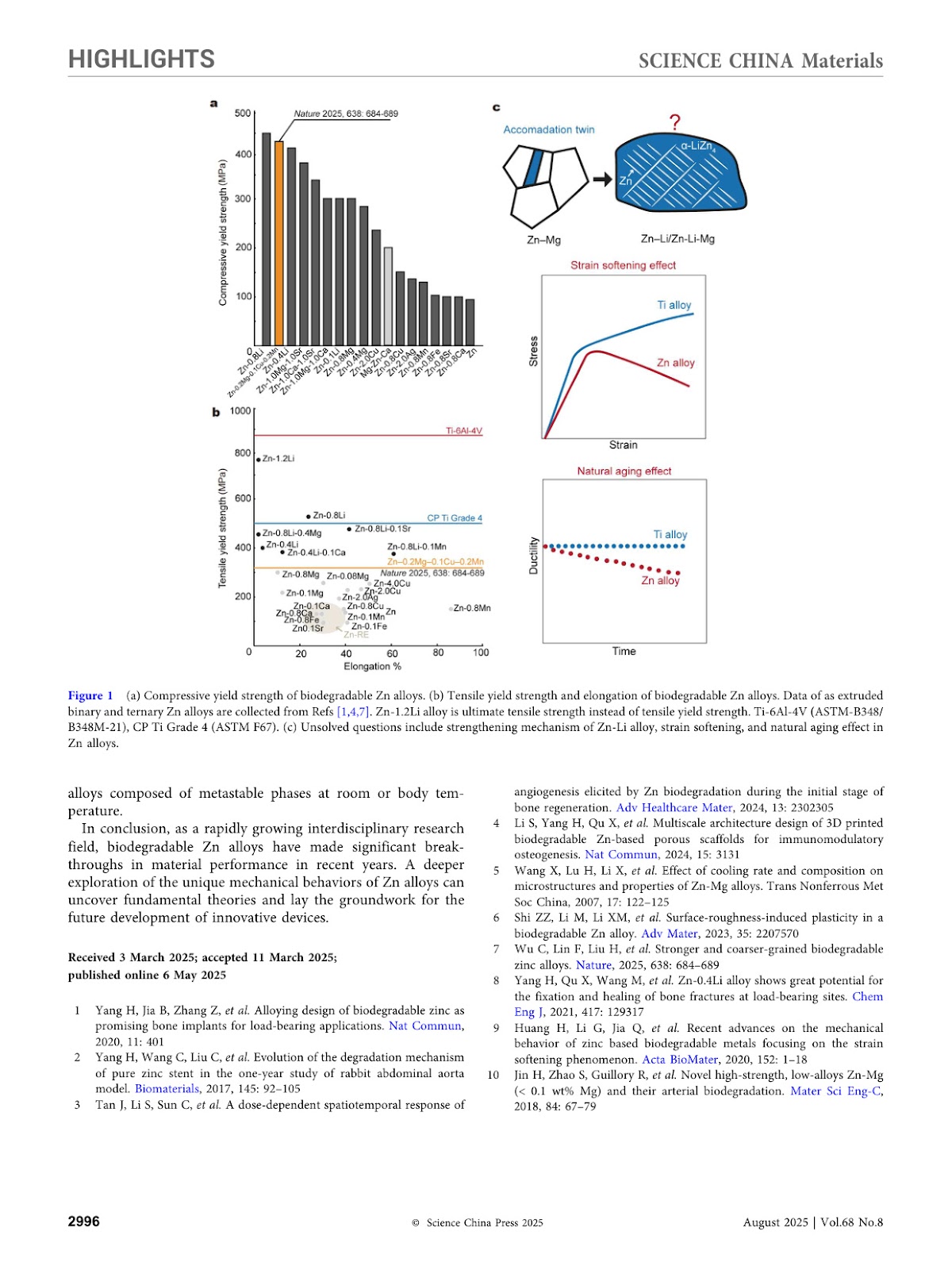
- •• • Coarse-grained Zn-0.2Mg (47 μm) exhibits higher yield strength than fine-grained (11 μm) counterparts, contradicting the Hall-Petch relationship; this enables compressive yield strengths exceeding 400 MPa in multi-component alloys (Zn-0.2Mg-0.1Cu-0.2Mn) with grain sizes of 10–50 μm, directly addressing the strength ceiling that limits Mg alloys in medium-load-bearing implants. • • Zn-Mn alloys demonstrate 143% room-temperature elongation via surface-roughness-induced plasticity, providing a ductility benchmark that mitigates the brittle fracture risk associated with fine-grained Zn alloys under physiological loading. • • In vivo degradation rates of Zn-based devices match tissue healing periods: 3–6 months for vascular healing and 2–3 months for bone healing, as validated by a 6-week in vivo study, ensuring implant integrity during critical healing phases without premature loss of mechanical support. • • Fine-grained Zn alloys exhibit reduced creep resistance at body temperature (approximately 0.45 homologous temperature), whereas coarse-grained variants show significantly improved creep resistance, extending implant durability under sustained physiological loads.
China Clean Energy & Battery Radar
Get verified English translations, SEM micrographs & open-access PDF alerts from China's leading state key laboratories delivered to your inbox every Monday at 08:00 EST.
Abstract
Biodegradable zinc (Zn) alloys have emerged as viable candidates for medium- to high-load-bearing implants, outperforming magnesium alloys in strength and ductility while exhibiting in vivo degradation rates that align with vascular (3–6 months) and bone (2–3 months) healing. Clinical translation has advanced to maxillofacial fixation, interference screws, and drug-eluting coronary stents. Alloy design has evolved from Zn-Mg and Zn-Li systems to Zn-Mn alloys that achieve 143% room-temperature elongation via surface-roughness-induced plasticity. Conventional strengthening relies on grain refinement, yet fine-grained Zn alloys suffer reduced creep resistance at body temperature (0.45 homologous temperature). A paradigm shift was introduced by Nie’s group: coarse-grained Zn-0.2Mg (47 μm) exhibits higher yield strength than fine-grained (11 μm) counterparts, defying the Hall-Petch relationship. This anomaly arises from accommodation twinning that maintains intergranular cohesion, shifting deformation from intergranular to intragranular mechanisms. Multi-component alloys (Zn-0.2Mg-0.1Cu-0.2Mn) achieve compressive yield strengths exceeding 400 MPa with grain sizes of 10–50 μm, alongside improved creep resistance and acceptable cytotoxicity relative to Mg-Zn-Ca. A 6-week in vivo study confirmed appropriate degradation. These findings establish grain coarsening as a counterintuitive but effective pathway for designing stronger, more durable biodegradable Zn alloys for load-bearing applications.
1. Introduction
Biodegradable magnesium (Mg) alloys have long been investigated for load-bearing implants, yet their rapid degradation and insufficient strength in medium- to high-load applications have stalled widespread clinical adoption. Zinc (Zn) and its alloys offer a superior combination of strength, ductility, and degradation kinetics that more closely match tissue healing periods—3–6 months for vascular and 2–3 months for bone healing. Despite these advantages, conventional alloy design has relied on grain refinement to enhance strength, which inadvertently compromises creep resistance at body temperature (0.45 homologous temperature), creating a bottleneck for long-term implant performance.
This study addresses the strength–creep trade-off by challenging the classical Hall-Petch relationship. Through intentional grain coarsening in Zn-Mg alloys, the authors demonstrate that coarse-grained Zn-0.2Mg (47 μm) achieves higher yield strength than its fine-grained counterpart (11 μm) via accommodation twinning, which maintains intergranular cohesion and shifts deformation to intragranular mechanisms. Multi-component alloys (Zn-0.2Mg-0.1Cu-0.2Mn) with grain sizes of 10–50 μm exhibit compressive yield strengths exceeding 400 MPa and improved creep resistance, while a 6-week in vivo study confirms appropriate degradation and acceptable cytotoxicity. This counterintuitive strategy opens a new pathway for designing durable Zn alloys for medium-load-bearing implants.
Loading authentic research manuscript (Pages 1–5)...
Hongtao Yang, Yufeng Zheng (2025). Breakthrough and Challenges for Biodegradable Zn Alloys: Grain Coarsening as a Strategy for Superior Strength and Creep Resistance. SCIENCE CHINA Materials. https://doi.org/10.1007/s40843-025-3327-8
Research & Educational Purpose Only: The translations, structured abstracts, analytical annotations, and data reports provided by SinoGreenTechare intended exclusively for academic research, internal corporate R&D, and educational benchmarking. They do not constitute formal engineering, chemical safety, legal, or professional advice.
Copyright & Intellectual Property Notice: Original copyright of the underlying source articles and experimental data remains with the respective authors, institutions, and original publishing journals. SinoGreenTech claims intellectual property only over its proprietary translations, analytical syntheses, and AEO structured enhancements in accordance with international fair use and academic citation principles.
Frequently Asked Questions
What is the specific failure mechanism that limits fine-grained Zn alloys in load-bearing applications, and how does grain coarsening mitigate it?
Fine-grained Zn alloys (e.g., 11 μm) exhibit reduced creep resistance at body temperature (0.45 homologous temperature) due to grain boundary sliding and dynamic recrystallization under low stress. Coarse-grained Zn-0.2Mg (47 μm) mitigates this by forming a large fraction of accommodation twins that maintain intergranular cohesion, shifting deformation from intergranular to intragranular mechanisms. This results in compressive yield strengths exceeding 400 MPa and significantly improved creep resistance, as demonstrated in the Zn-0.2Mg-0.1Cu-0.2Mn alloy.
How does the degradation rate of Zn alloys compare to the healing periods of vascular and bone tissues, and what in vivo evidence supports this?
Zn-based devices degrade at rates matching tissue healing periods: 3–6 months for vascular healing and 2–3 months for bone healing. A 6-week in vivo study confirmed appropriate degradation of the Zn-Mg alloy system, ensuring mechanical integrity during critical healing phases without premature loss of support. This contrasts with Mg alloys, which often degrade too rapidly.
What are the cytotoxicity profiles of the Zn-Mg-Cu-Mn alloy system relative to FDA-approved Mg alloys, and what clinical translation has been achieved?
The Zn-0.2Mg-0.1Cu-0.2Mn alloy exhibits good cytotoxicity compared to the Mg-Zn-Ca alloy, a variant of the FDA-approved Mg alloy system. Clinical studies have been initiated for biodegradable Zn alloy devices, including a maxillofacial internal fixation system, interference screws, and a resorbable Zn alloy drug-eluting coronary artery stent, demonstrating progress toward regulatory approval.
What are the scalability and cost challenges for manufacturing coarse-grained Zn alloys with superior strength and creep resistance?
Coarse-grained Zn alloys require precise control of grain size (10–50 μm) and alloying content (e.g., 0.2% Mg, 0.1% Cu, 0.2% Mn) to achieve compressive yield strengths exceeding 400 MPa. Unlike conventional grain refinement, this approach avoids complex severe plastic deformation, potentially reducing processing costs. However, maintaining homogeneity and avoiding unintended fine-grained regions during casting and thermomechanical processing remain scalability bottlenecks that must be addressed for industrial production.
How does the anomalous Hall-Petch behavior in coarse-grained Zn-Mg alloys affect long-term implant durability under physiological loading?
The anomalous behavior—where coarse-grained Zn-0.2Mg (47 μm) exhibits higher yield strength than fine-grained (11 μm)—is attributed to accommodation twinning that accommodates altered grain shapes and maintains cohesion. This mechanism enhances creep resistance at body temperature, extending implant durability under sustained loads. The Zn-0.2Mg-0.1Cu-0.2Mn alloy demonstrates the best strength and creep resistance, making it suitable for medium-load-bearing applications where Mg alloys fail.
Related Chinese Research & Cross-Citations

Ammonium Vanadate Cathodes in Aqueous Zinc-Ion Batteries: Design Strategies and Research Progress
Aqueous zinc-ion batteries (AZIBs) offer a compelling combination of high safety, environmental compatibility, and abundant zinc resources, positioning them as viable candidates for grid-scale energy storage. Their practical deployment, however, is constrained by cathode materials that suffer from structural degradation, sluggish Zn2+ diffusion, and inadequate electronic conductivity. Ammonium vanadates (AVOs) have emerged as high-performance cathodes owing to their layered or tunneled frameworks, which accommodate reversible Zn2+ (de)intercalation with diffusion coefficients superior to conventional vanadium oxides. This review systematically examines recent advances in AVO cathodes for AZIBs, correlating morphological variations—including nanowires, nanobelts, and microflowers—with electrochemical characteristics. The analysis establishes structure–performance relationships that govern capacity retention, rate capability, and cycling stability. Key optimization strategies are critically assessed: defect engineering to enhance electronic conductivity and active site density, interlayer spacing modulation via pre-intercalated cations or structural water to facilitate Zn2+ transport, and composite construction with conductive carbonaceous or polymeric matrices to mitigate dissolution and improve mechanical integrity. Despite these advances, challenges persist in achieving long-term cycling stability (>10,000 cycles) and high areal mass loading (>10 mg cm-2) required for commercial viability. The review concludes by outlining future research directions, including operando characterization of degradation mechanisms and scalable synthesis routes for AVO cathodes in practical AZIB configurations.

Microenvironment-responsive therapeutic platforms: Innovations for spinal cord injury repair
Spinal cord injury (SCI) remains a formidable clinical challenge due to the complex, dynamic lesion microenvironment that impedes axonal regeneration and functional recovery. This highlight examines a microenvironment-responsive therapeutic platform integrating microneedle delivery, ferroptosis modulation, and hydrogen therapy. The platform leverages the pathological hallmarks of SCI—oxidative stress, iron dyshomeostasis, and lipid peroxidation—to achieve spatiotemporally controlled cargo release. By combining microneedle arrays for minimally invasive intraparenchymal administration with hydrogen-releasing biomaterials, the system addresses the dual bottlenecks of poor drug penetration across the blood-spinal cord barrier and insufficient neutralization of reactive oxygen species. Ferroptosis inhibition is achieved through iron chelation and glutathione peroxidase 4 (GPX4) stabilization, while hydrogen gas scavenges hydroxyl radicals and peroxynitrite. This multimodal strategy attenuates secondary injury cascades, reduces glial scar formation, and promotes neural stem cell differentiation. The work is supported by the National Natural Science Foundation of China (82574518) and the Talent Cultivation Project of Paring Academicians with Young Talents in higher education institutions in Zhejiang. The authors declare no conflict of interest. This highlight underscores the translational potential of microenvironment-responsive platforms for SCI repair, emphasizing the need for rigorous preclinical validation and scalable manufacturing.

Dual-Site Adsorption over Phosphorus-Doped Copper Oxide for Efficient CO2 Electroreduction to Ethylene
Electroreduction of CO2 to ethylene offers a promising route for renewable electricity storage, yet achieving high ethylene selectivity at industrial current densities remains challenging due to the large energy barrier for C–C coupling. Here, we report a “MOF-assisted in situ doping” strategy to introduce the oxophilic nonmetal phosphorus (P) into the copper oxide (CuO) lattice, constructing a localized Cu–P dual-site adsorption configuration for the key *OCCHO intermediate. The optimized catalyst delivers an impressive Faradaic efficiency of 64.6% for ethylene with a partial current density of 646 mA cm-2. Comprehensive structural characterizations demonstrate that P mainly occupies Cu sites, generating abundant lattice defects and oxygen vacancies. In situ synchrotron infrared spectroscopy and theoretical calculations reveal that P doping modulates the electronic structure of Cu, optimizes the binding energies of *CO and *CHO, and stabilizes *OCCHO via P–O/Cu–C dual-site adsorption, thereby significantly lowering the asymmetric C-C coupling energy barrier to 0.74 eV. This work highlights a dual-site microenvironment regulation strategy for CO2-to-ethylene electroreduction.

Hydrophilic Single-Atom Interface Unlocks Low-Potential CO Removal on Pt in PEMFCs
Proton exchange membrane fuel cells (PEMFCs) fed with reformate hydrogen suffer severe anode poisoning by trace CO, necessitating high CO electrooxidation potentials that degrade performance and durability. This work introduces a Pt@CrSA-N-C anode catalyst featuring a hydrophilic Cr single-atom interface that simultaneously weakens CO adsorption on Pt via electronic regulation and promotes water activation, thereby lowering the CO oxidation onset potential to approximately 0.13 V vs. RHE. The onset potential was determined by two independent methods: the first potential at which the background-corrected current exceeds 0 mA cm-2 during CO oxidation reaction tests in a three-electrode system, and the potential at which the forward scan current exceeds the N2 background current in CO-stripping voltammetry. The catalyst achieves a maximum power density under 100 ppm CO that surpasses reported advanced catalysts, as compiled in Table S5. Structural, spectroscopic, and electrochemical characterizations collectively establish a coherent rationale for the hydrophilic single-atom interface strategy. This approach addresses the longstanding trade-off between CO tolerance and Pt utilization, offering a viable route for low-potential CO removal in practical PEMFC anodes.

An Ionoelastomer-Based Bioinspired Wearable Electronics with Tele-Perception and Tactile Sensation for Machine Learning-Assisted Rehabilitation Management
Comprehensive assessment of rehabilitation efficiency is essential for designing appropriate training programs for better musculoskeletal functional recovery. Existing contact-receptor-dependent rehabilitation assessment systems mostly focus on assessing the restoration of muscle function by evaluating grip strength or joint flexion angle; however, parameters reflecting neuromuscular synergistic function are always overlooked. Herein, we develop an ionoelastomer-based soft artificial electroreceptor (SAER) that integrates tele-perception and tactile sensation to track the rehabilitation process, collecting signals related to approaching speed and grip strength sequentially. The SAER uses polyurethane ionoelastomer incorporated with quasi-solid conductive salt as the electric field receptor, and is integrated on a rehabilitation-training ball after assembly to establish an untethered detection device; this enables the remote capture of hand approaching parameter within a 9 cm range, followed by the quantification of grip strength when contacting and grasping. Furthermore, a data-driven assessment system is established by integrating machine learning, which accurately classifies rehabilitation efficiency into six levels; it supports for rehabilitation evaluation and training programs adjustment. Overall, the SAER-based rehabilitation management system establishes a paradigm that synergistically evaluating parameters corresponding to neuromuscular functional restoration and holds strong potential for home-based active rehabilitation for minimizing dependence on frequent clinical supervision.

Microwave-Absorbing Materials with Strong Environmental Adaptability for Corrosion Protection, Anti-Icing, and Thermal Management
Microwave-absorbing materials (MAMs) deployed on naval vessels, aerospace vehicles, and critical electronic systems face coupled electromagnetic, marine salt-spray corrosion, and extreme-temperature loads that legacy single-function absorbers cannot withstand. This review consolidates progress on three environmentally adaptive MAM classes: corrosion-protective, anti-icing, and thermal-management absorbers. The electromagnetic loss and impedance-matching fundamentals are first established, then the synergistic mechanisms, design strategies, and characterization protocols for each class are examined against representative material systems and their measured performance. The analysis identifies a shared design logic—multiscale hierarchical architecture, interfacial polarization engineering, and multifunctional phase integration—while distinguishing the divergent protection mechanisms: barrier and passivation effects for corrosion, surface-energy and latent-heat regulation for anti-icing, and phonon–electron transport decoupling for thermal management. Persistent bottlenecks include the trade-off between impedance matching and protective-layer density, the absence of standardized coupled-field test protocols, and the scarcity of long-term salt-spray and thermal-cycling durability data. Future directions are delineated: intelligent self-adaptive absorbers, multiphysics-coupled simulation frameworks, and environmentally benign multifunctional integration. The review provides a theoretical and technical basis for the design, construction, and engineering scale-up of next-generation high-performance absorbers for aerospace, electronic, and marine equipment.